
The survey tells you what is in the building. The plan tells you what you are going to do about it, who is doing it, and how you will know it has been done.
If a contractor drills into a ceiling panel on a Tuesday afternoon, the survey does not help much. The plan is what should have stopped it, and it is what tells everyone what happens next.
The essentials
- The law
- Regulation 4, Control of Asbestos Regulations 2012. The duty to manage.
- Who it applies to
- Whoever is responsible for maintenance and repair of the premises. For an academy, that is the trust.
- Which buildings
- Anything built before 2000 should be presumed to contain asbestos until a suitable survey says otherwise.
- What you need
- A survey, an up to date register, a risk assessment, and a written management plan that is acted on.
- Review
- At least every 12 months, and sooner if anything changes.
- Re-inspection
- Risk based. The law sets no fixed interval. HSE guidance expects no more than 12 months between checks in most cases, and more frequent checks where there is a lot of activity.
- Key guidance
- DfE, Managing asbestos in your school or college (updated March 2025), plus HSE's duty to manage guidance and HSG264.
What the duty to manage actually asks of you
Strip the regulation back and there are six things. Find out whether asbestos-containing materials are present, where, and in what condition. Keep a record of that. Assess the risk of anyone being exposed. Write a plan for managing the risk. Put the plan into action and keep it under review. Tell anyone liable to disturb the material where it is.
Schools are generally good at the first two, because a surveyor does them. It is the last four that slip, because they belong to you and they never finish.
Who owns the plan?
The dutyholder does. DfE's guidance sets out who that is likely to be:
| Setting | Likely dutyholder |
|---|---|
| Local authority maintained school | The local authority |
| Academy or multi-academy trust | The academy trust |
| Voluntary aided school | The governing body |
| Foundation school | May be shared between several bodies |
| Sixth form or FE college | The corporation |
Legal responsibility sits with the dutyholder, but the plan only works at site level. A trust can hold a well written central policy and still have a school where the site manager has never opened the register. A good plan names both: who is accountable, and who does the day to day work in each building.
If responsibility for maintenance is split, through a lease or a PFI contract for example, write down who does what. Ambiguity is where asbestos incidents come from.
What a school plan must contain
DfE is specific about this, which makes it a useful checklist to hold your current plan against.
- Leadership statementWho owns the risk, and a commitment to training and resourcing.
- Roles and responsibilitiesNamed people, with deputies for when they are away.
- The asbestos registerOr a clear pointer to the one live version.
- Remedial work plansWhat needs urgent action, and what is managed in place.
- Monitoring arrangementsHow and when each ACM's condition is checked.
- Hidden or presumed asbestosVoids, risers, and anywhere the survey could not reach.
- Routine maintenance controlsHow a caretaker knows whether a wall is safe to fix to.
- Construction and refurbishmentIncluding when an R&D survey is needed first.
- Emergency proceduresWhat happens after an accidental disturbance.
- CommunicationWhat staff, contractors and visitors are told, and how.
- Reporting and escalationFor damage or deterioration.
- GovernanceDocument control, version history and review dates.
If your plan is two pages saying asbestos will be managed in accordance with the regulations, it is a policy statement, not a plan.
The honest test is not “do we have a plan?” It is “could someone who started last week follow it?”
The detail worth noticing: the priority assessment is yours
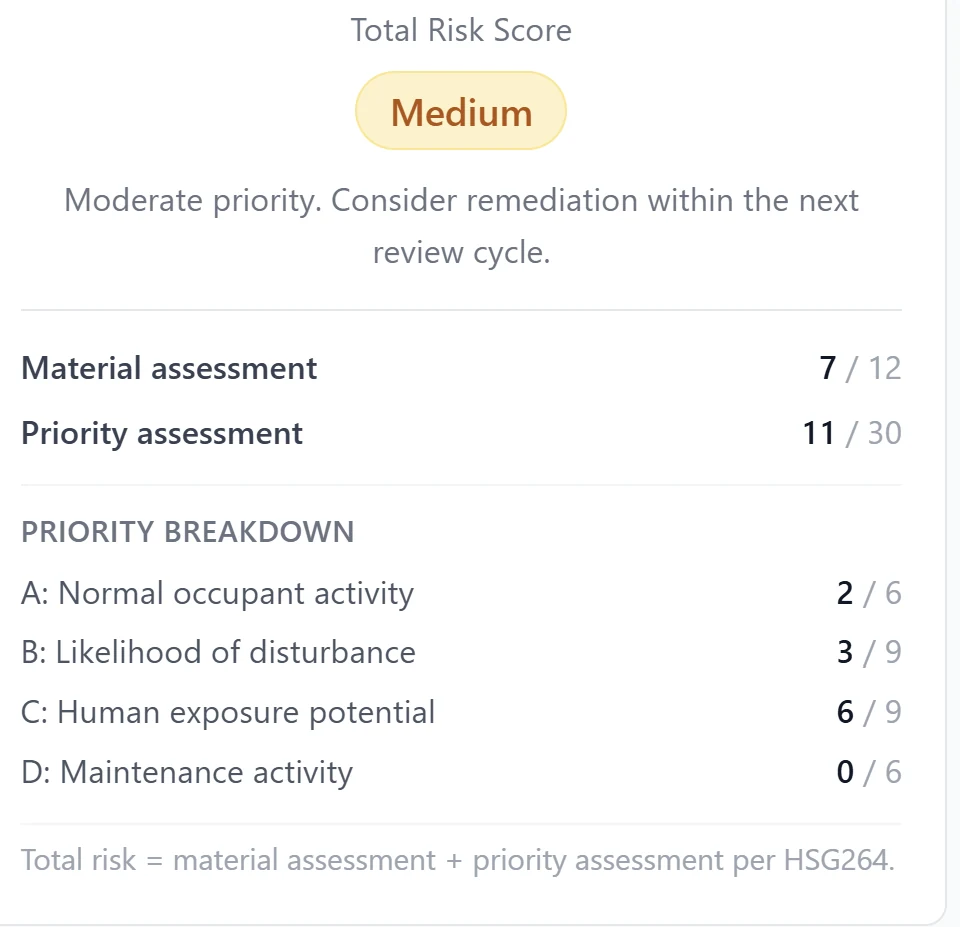
A survey gives each material a material assessment score: product type, extent of damage, surface treatment, asbestos type. That tells you how readily it would release fibres if disturbed. The surveyor is well placed to judge that.
What the surveyor cannot judge is how your building is used. Who is in that room, for how long, how likely the material is to be knocked, how often maintenance goes near it. That is the priority assessment, and it belongs to the dutyholder. An insulating board panel in a locked plant room and the same panel at shoulder height in a Year 3 corridor are not the same risk.
Plenty of schools never do this step. The surveyor's scores get treated as the final word, and the action plan is built on half the picture.
What should a school asbestos management plan contain?
A practical plan should identify who is responsible, the premises and asbestos register it covers, how risks and actions are managed, arrangements for re-inspection and building work, staff and contractor information, emergency procedures, and how the plan is monitored and reviewed.
Our free template puts these requirements into a practical structure that schools and academy trusts can complete and keep up to date.
Free school asbestos management plan template
A practical, editable template for schools and academy trusts in England, covering dutyholder responsibilities, the asbestos register, risk assessment, action planning, re-inspections, contractor controls, training, emergency procedures and ongoing review.
No email address required.
Where this usually falls down
None of the common failures are about knowledge. They are about keeping a live document live.
- The plan and the register drift apart. Material comes out during summer works and the register still shows it a year later.
- Re-inspections happen but nothing changes. A condition score drops and no action is raised.
- Contractors sign in but never see the register. Sharing it before work starts is a legal requirement, not a courtesy.
- Named people have left. The responsible person on the front page moved on two years ago.
- Survey caveats are forgotten. “No access” areas get treated as clear when they should be presumed to contain asbestos.
- It lives in a folder in the site office. Nobody at trust level can see whether it is current.
The information usually exists. The challenge is that it lives in a 200 page PDF, a spreadsheet someone built in 2019, and the site manager's memory.
What it looks like when the survey becomes the plan
This is the problem we built the asbestos module in EduComply to solve. You upload the survey you already have. It walks you through six steps, and it does not mark the survey as managed until all six are done.
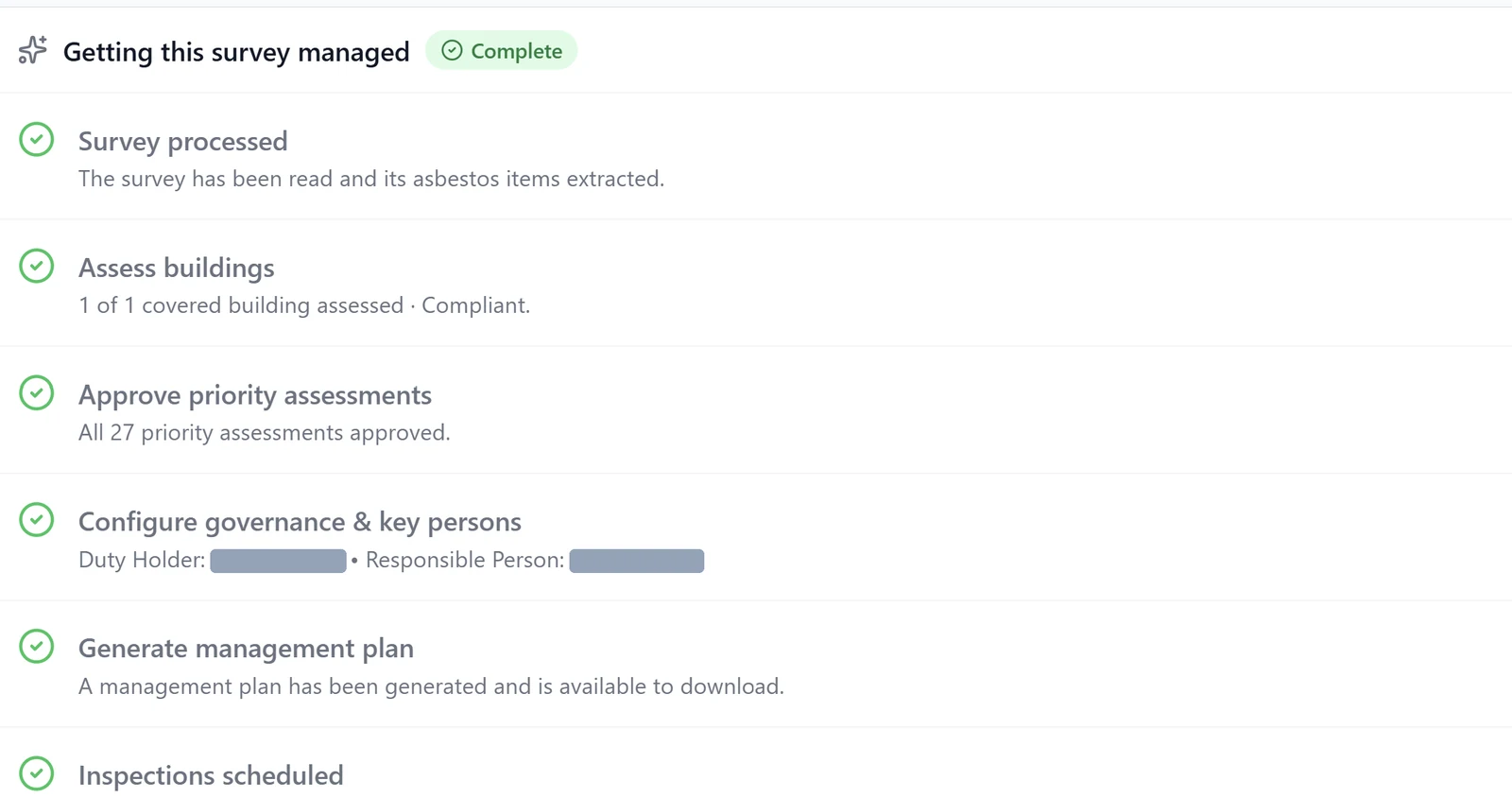
- 1Survey processed. The survey is read and its asbestos items extracted into a structured register: location, material, condition, sample reference, recommendation. No retyping.
- 2Assess buildings. Each building the survey covers is confirmed, so gaps in coverage are visible rather than assumed away.
- 3Approve priority assessments. The dutyholder's half of the risk picture. Each one is reviewed and approved by a person who knows the building. Nothing is signed off on your behalf.
- 4Configure governance and key persons. Dutyholder and responsible person are named. When someone moves on, you change it once and the plan follows.
- 5Generate management plan. A versioned plan is produced from the live register, so the two cannot drift apart.
- 6Inspections scheduled. Recurring re-inspections are set automatically, per building, from the approved assessments.
Once that is done, the register stops being a document and becomes a picture of the estate. How many ACMs, what the survey recommended for each, how risk is distributed, which actions are urgent, and which rooms carry the most risk.

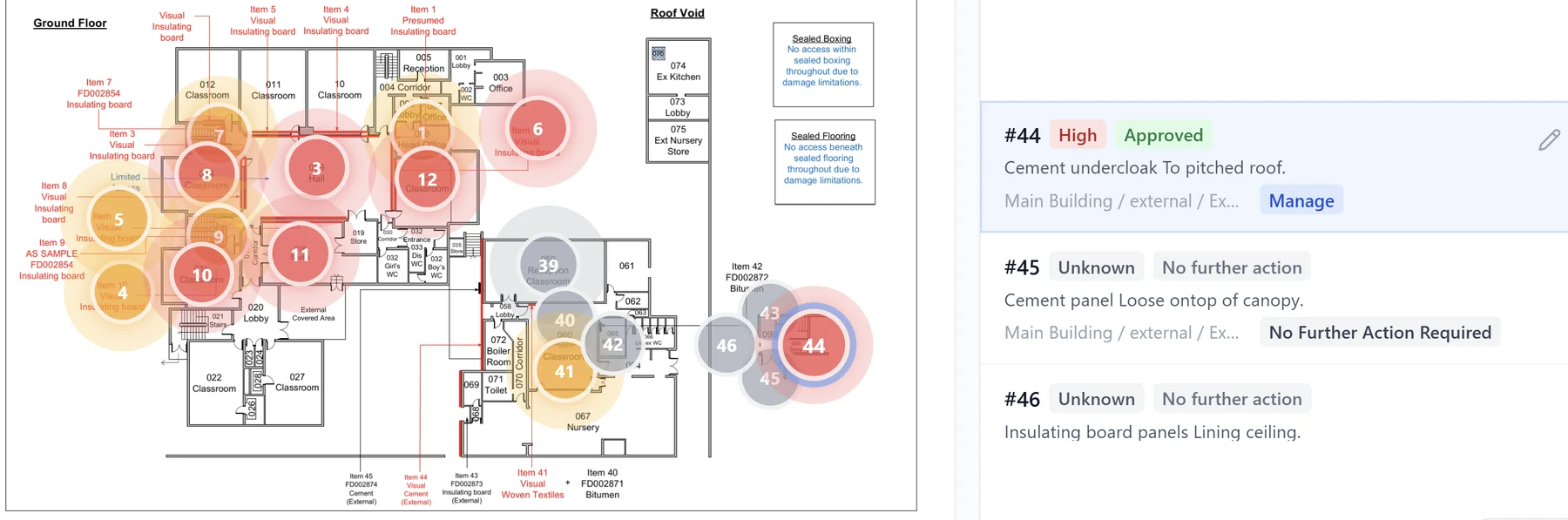
The floor plan at the top of this article is the same data again. The surveyor's drawing, with every ACM as a marker you can click through to its register entry, photos and score. Site staff can also scan a QR code at the location to see what is recorded before they start work, and that acknowledgement is kept.
Questions we get asked
Is an asbestos management plan the same as an asbestos survey?
No. The survey identifies materials. The plan sets out how the risk from those materials is managed. You need both, along with a register.
Do we need a plan if the survey found no asbestos?
If a suitable survey confirms no ACMs, or the building was constructed after 2000, you do not need a full plan. Keep the evidence, and be careful with management surveys that list areas not accessed.
Who should write the plan?
The dutyholder is responsible for it. A competent consultant can help draft it, but it has to reflect how your school actually runs, so involve site staff.
Can a trust have one plan for all its schools?
A trust wide framework makes sense, but each site needs its own specifics: its register, named people, re-inspection schedule and local procedures.
How long should we keep records?
Keep plan versions, re-inspection records and contractor acknowledgements for as long as you hold the building. If anyone is ever exposed, you will want to show what was known and when.
Keep the plan live, not in a folder
A Word document is useful for creating the plan. Keeping the underlying register, actions, re-inspections and evidence current is the harder part.
EduComply turns the asbestos survey you already have into a live register, tracks actions and re-inspections, and keeps the management plan aligned with the underlying records.
For the wider duty to manage, read Asbestos management in schools. Prefer to ask a question first? Contact us.